UltraDim
The first vector store built for wide vectors and analytics too, not just retrieval — cluster, classify, visualise and detect anomalies straight off the index, at full vectors.
Mainstream vector stores assume hundreds to a few thousand dimensions. Scientific and analytical data breaks that assumption: whole-genome methylation profiles span tens of millions of CpG sites, molecular fingerprints hash into thirty-million-bit spaces, customer×product matrices reach hundreds of thousands of columns. UltraDim was built for exactly this regime — ultra-wide and sparse — where conventional stores collapse under their own memory cost long before they can answer a query.
The breakthrough is mathematical, not just engineering. UltraDim represents ultra-wide, sparse data in a new type of data index that stays exact yet scales with a better big-O — so the big datasets that break other stores simply aren’t a barrier for us. We multiply the gains too — our index powers search but also clustering, visualisation, embedding, recommendation and anomaly detection alike. Not just retrieval — an analytical environment.
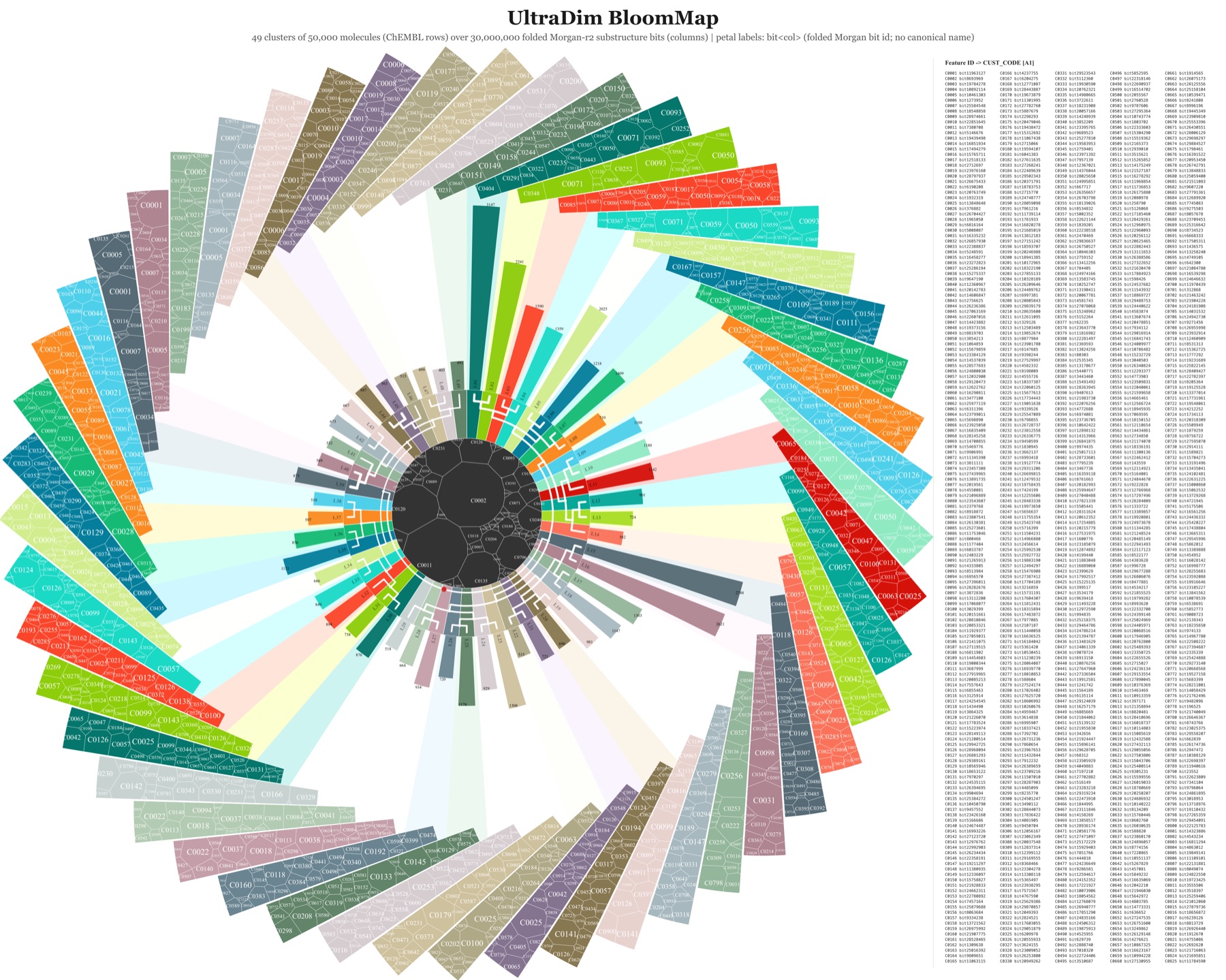
Measured, on one laptop
| Operation & corpus | width | measured result |
|---|---|---|
| Search — ChEMBL, 500k molecules | 3×10⁷ | recall@10 0.9964 @ 29 ms |
| Search — DBpedia-1M, dense | 1,536 | precision@10 0.9945 · 1,339 q/s @ 2.99 ms |
| Search — retail baskets, 100k | 100,000 | recall@10 0.9851 @ 17.5 ms |
| Search — synthetic, 50k | 1.8×10⁶ | recall@10 1.000 @ 15.7 ms |
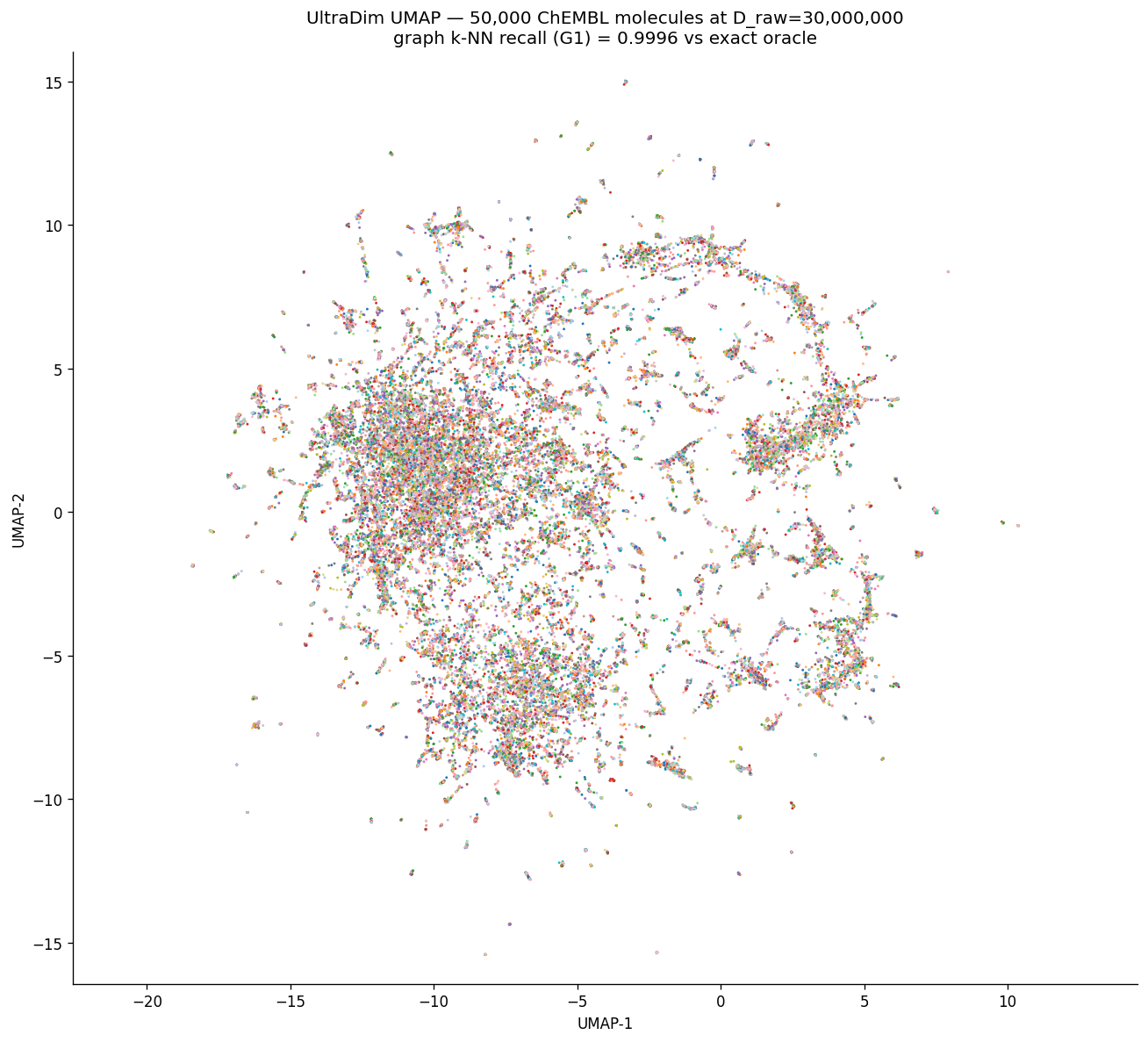
| Embedding — ChEMBL UMAP, 50k | 3×10⁷ | graph k-NN recall 0.9996 vs exact |
| Recommendation — MovieLens-20M | 20,720 | ties trained MF, zero training |
| Factorisation — retail spend | — | 0.80 correlation, above ALS ceiling |
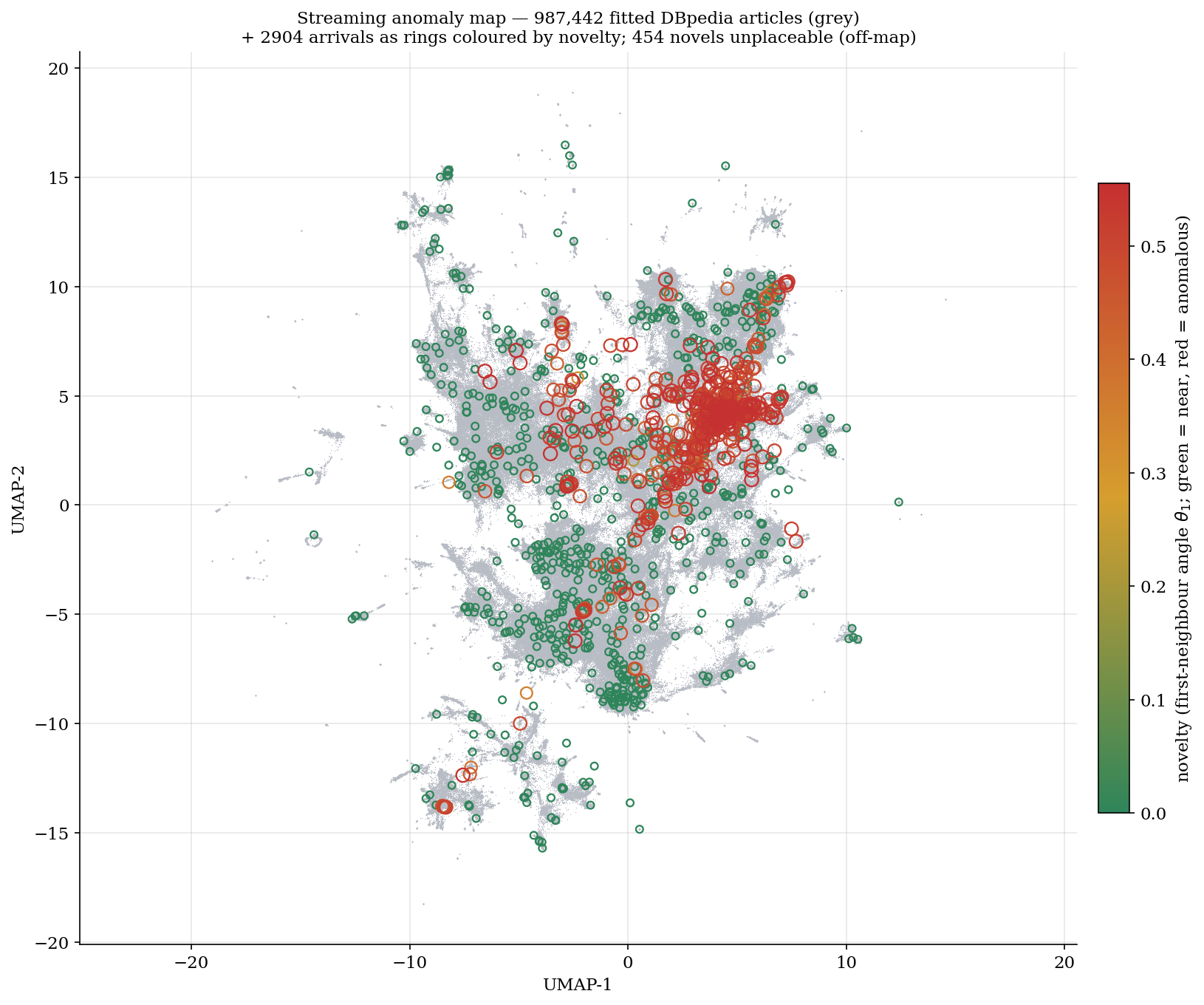
| Streamed anomaly — DBpedia · ChEMBL | 3×10⁷ | AUROC 1.0 · 247/s, real time |
All figures from the UltraDim technical paper, single Apple M3 Max host, measured against exact brute-force oracles. Cold-start and comparison caveats are disclosed in the paper — approximation is measured, not hidden.
What it does
- Similarity search — exact re-ranked cosine k-NN at extreme width
- Clustering — hierarchical spherical k-means on reused keys
- Embedding — UMAP maps with millisecond out-of-sample transform
- Recommendation — collaborative filtering at full fidelity, or matrix factorisation
- Streaming — novelty as a measured angle, drift as lineage disagreement
- Real-time anomaly detection on ultra-wide vectors — live arrivals scored at ~1.1 ms p50, even at 30-million-D (aka fraud detection)
Early access is open
We are inviting research groups and industrial teams with difficult vector datasets — molecular fingerprints, genomic profiles, spectra, sparse behavioural matrices. Free for academics.
apply for early access read the paper